
The final trailer for Denis Villeneuve’s Dune: Part Three landed on October 27, and it is the darkest look yet at the end of the trilogy. Nineteen years after Part Two, Paul Atreides is no longer the rising hero — he is the Padishah Emperor, bald, scarred, and hardened, presiding over a holy war that has conquered thousands of worlds. The trailer’s shock is not a sandworm. It is Chani: Zendaya’s character is shown openly opposing Paul, fighting him, and seemingly joining the conspiracy against him — a sharp break from Frank Herbert’s Dune Messiah, where she stays loyal. “Do not fear the end,” the trailer’s tagline says. Here is how to steal that look with AI video, shot by shot.
It is Villeneuve’s adaptation of Dune Messiah, co-written with Brian K. Vaughan, in theatres and IMAX on December 18, 2026 (December 16 internationally). The film stars Timothée Chalamet, Zendaya, Jason Momoa, Florence Pugh, Rebecca Ferguson, Charlotte Rampling, Anya Taylor-Joy, Robert Pattinson, and Javier Bardem.
The look in 30 seconds
- Empire, not desert: palace intrigue replaces open dunes — cold stone, throne rooms, and propaganda staging
- The oppressor’s palette: spice-orange desert cut by cold imperial grey and the bleached white of Scytale
- Weathered faces: nineteen years of war on everyone — scars, Paul’s burn-marked eyes, older and harder faces
- Propaganda scale: vast armies arranged like a rally, the emperor tiny on a platform above them
- Blood as punctuation: a blood-covered Alia is the trailer’s single most arresting image
- Intimate vs immense: whispered interrogations in dark rooms, then sandworms and armies in IMAX-wide frames
Shot 1 — The Voice interrogation
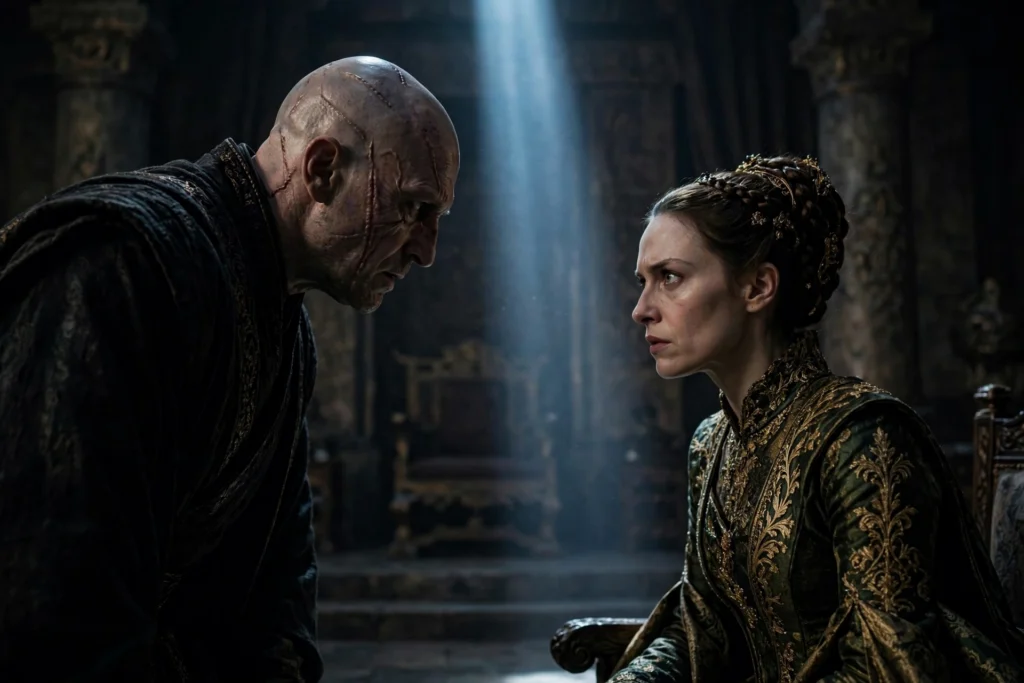
The shot: Paul uses the Voice on his wife, Princess Irulan, to force out what she knows. Her answer sets the whole trailer in motion: “There will be an assassination attempt. Chani’s involved.”
Why it works: The trailer opens as an interrogation, not a battle. One calm, compelled voice in a dark room tells you this film is a political thriller wearing a desert epic’s clothes.
The AI prompt:
Photorealistic cinematic still, dim imperial throne room at night, a bald scarred emperor in dark robes leaning toward a seated noblewoman in an ornate gown, her face caught between defiance and compulsion, a single cold shaft of light between them, deep shadows, tense hushed stillness, original fictional faces, no text.
Tool tip: The Voice is a performance, not a visual — sell it with the listener’s face, not the speaker’s. “Caught between defiance and compulsion” gives the generator the conflict to render.
Shot 2 — Emperor on the platform
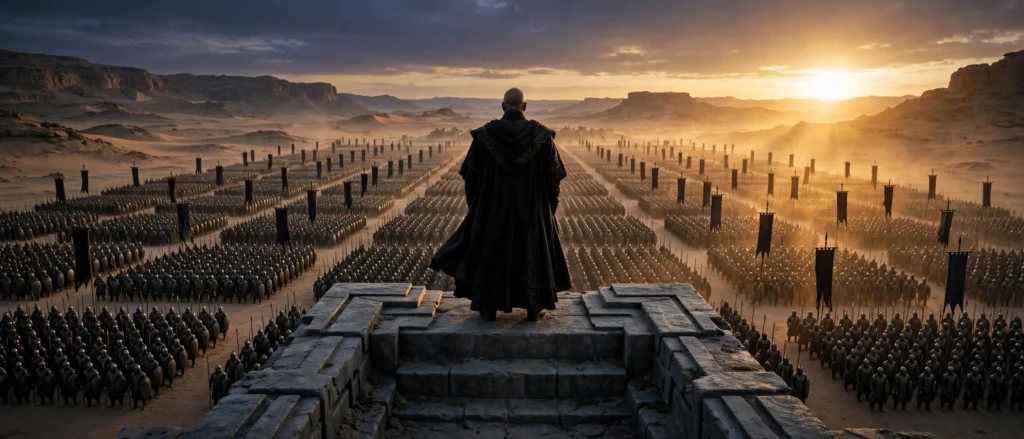
The shot: Paul stands on a raised platform before a massed army, in a composition that looks straight out of a propaganda film — the emperor above his people, the people arranged below him like a rally.
Why it works: This is the whole film in one frame: the hero of the first two films restaged as a dictator. The scale flatters him and indicts him at the same time.
The AI prompt:
Photorealistic cinematic still, vast desert rally at dusk, a lone bald emperor in dark robes standing on a high stone platform above a massed army in strict rows, banners hanging still, harsh amber light against cold grey stone, anamorphic widescreen composition, monumental propaganda staging, no text.
Tool tip: Keep the emperor small in frame — the power is in the crowd’s geometry, not his face. “Strict rows” and “monumental staging” stop the generator from turning it into a portrait.
Shot 3 — The conspiracy
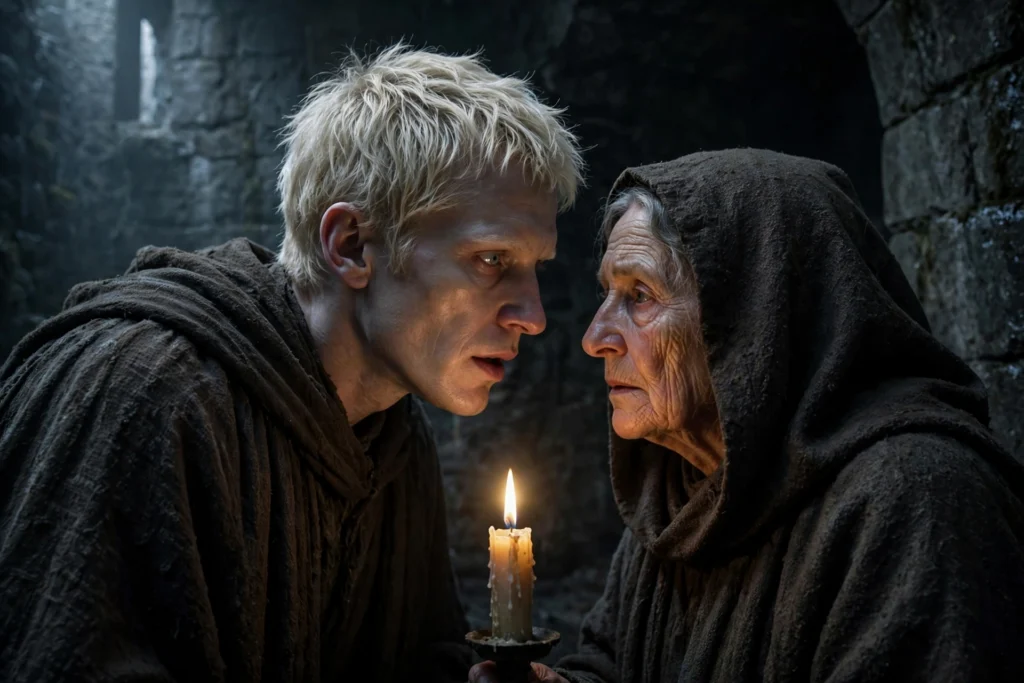
The shot: Scytale, pale-skinned with bleached-blond hair and no eyebrows, schemes with Reverend Mother Mohiam. “We found a way to neutralise the emperor and end this madness,” he says.
Why it works: The villain of this film does not look like a monster — he looks grown in a lab, blank and eerie. The menace is that he can pass unnoticed, and the shot is two people talking in a room.
The AI prompt:
Photorealistic cinematic still, shadowed stone chamber, a pale man with bleached-blond hair and no eyebrows leaning close to an elderly robed woman, whispering a conspiracy, a single candle flame between them, cold grey light, unsettling stillness, original fictional faces, no text.
Tool tip: “Blank and eerie, not monstrous” is the whole design — if you write “villain” the generator will add horns and shadows. Describe the face, not the role.
Shot 4 — Chani turns
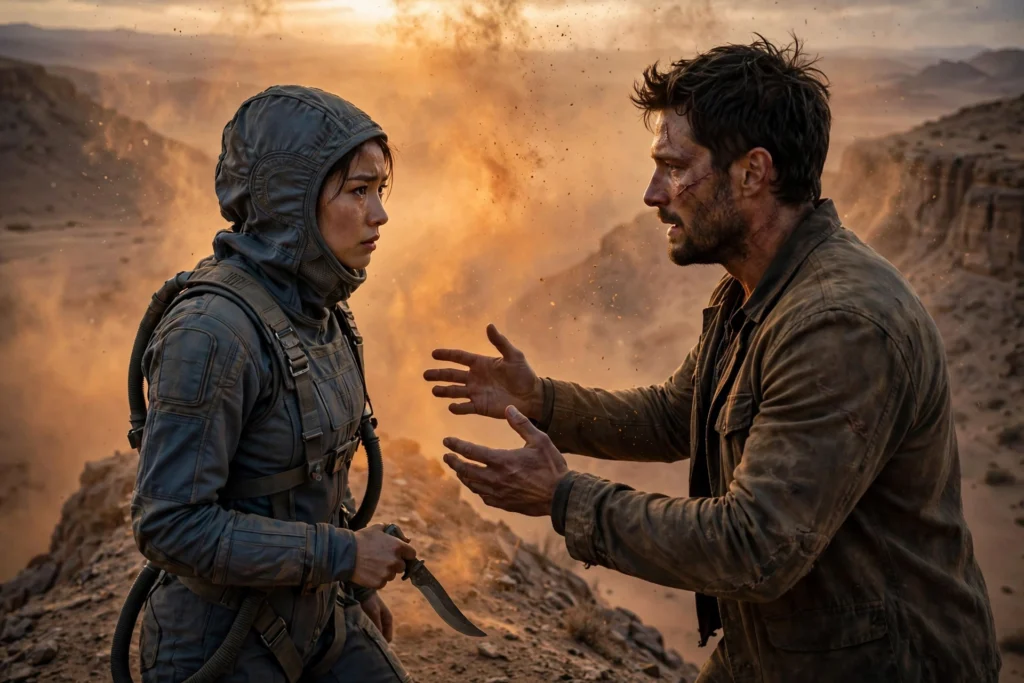
The shot: Chani fights against Paul and seems to join the plot — Scytale asks her, “Ready?” and she answers, “Fremen keep their word.” The trailer ends on the two of them in a haze of spice: “I was doing this for our children!” — “I’m doing this for you.” — “There’s nothing I can say to make amends.” Then she runs to embrace him.
Why it works: This is the trailer’s argument, and the one every viewer will fight about. Is it really Chani, or is Scytale — a Face Dancer who can copy anyone — wearing her shape to goad Paul into a trap? The film never lets you settle it, and the look has to hold both readings.
The AI prompt:
Photorealistic cinematic still, two former lovers facing each other in a spice-orange haze at dusk on a desert ridge, a woman in a stillsuit holding a blade low, a scarred man reaching toward her with open hands, wind-blown spice dust glowing in the last light, grief and defiance in equal measure, original fictional faces, no text.
Tool tip: The ambiguity is the shot — “grief and defiance in equal measure” keeps the generator from deciding for you whether she is traitor or victim.
Shot 5 — Hayt returns
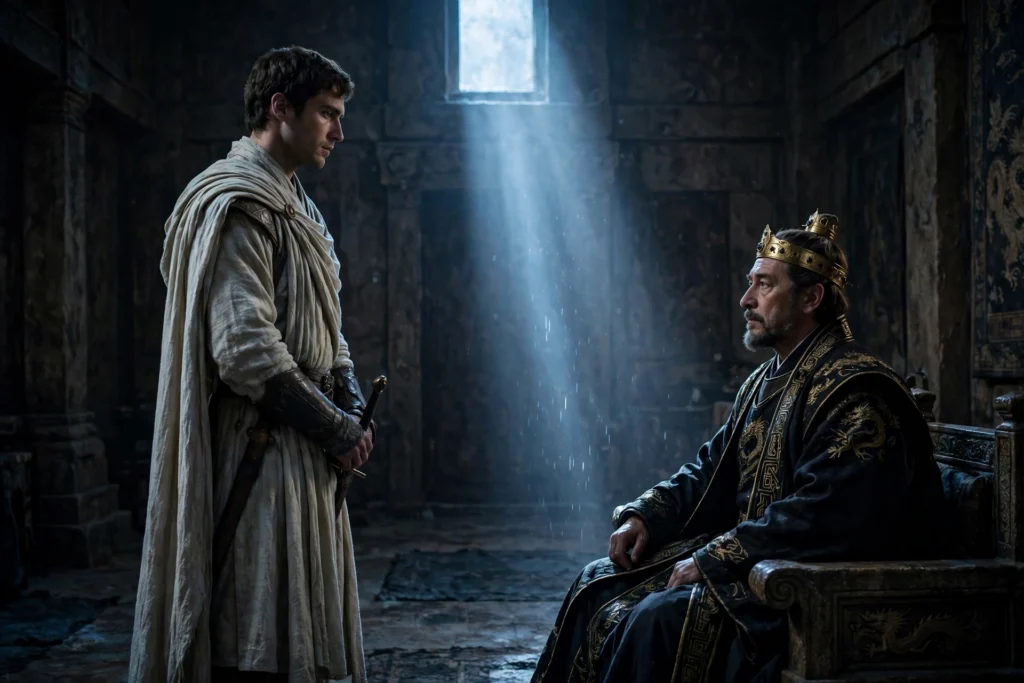
The shot: Duncan Idaho is back — as Hayt, a clone grown from the dead man’s cells, built by the conspirators to get close to the family. Paul asks him, “Promise you will protect my family?” Hayt answers, “My emperor, don’t you have the power to stop this?”
Why it works: A dead friend, rebuilt as a weapon, asking the emperor the one question he cannot answer. The look is a reunion staged as a threat.
The AI prompt:
Photorealistic cinematic still, a tall warrior in pale robes standing before a seated emperor in a dim hall, the warrior’s face calm and unfamiliar despite the familiar frame, cold light from a high window falling between them, a reunion that feels like a warning, original fictional faces, no text.
Tool tip: “Familiar frame, unfamiliar face” is the clone in one line — it tells the generator to keep the body language warm and the expression wrong.
Shot 6 — Sandworms, armies — and the twins
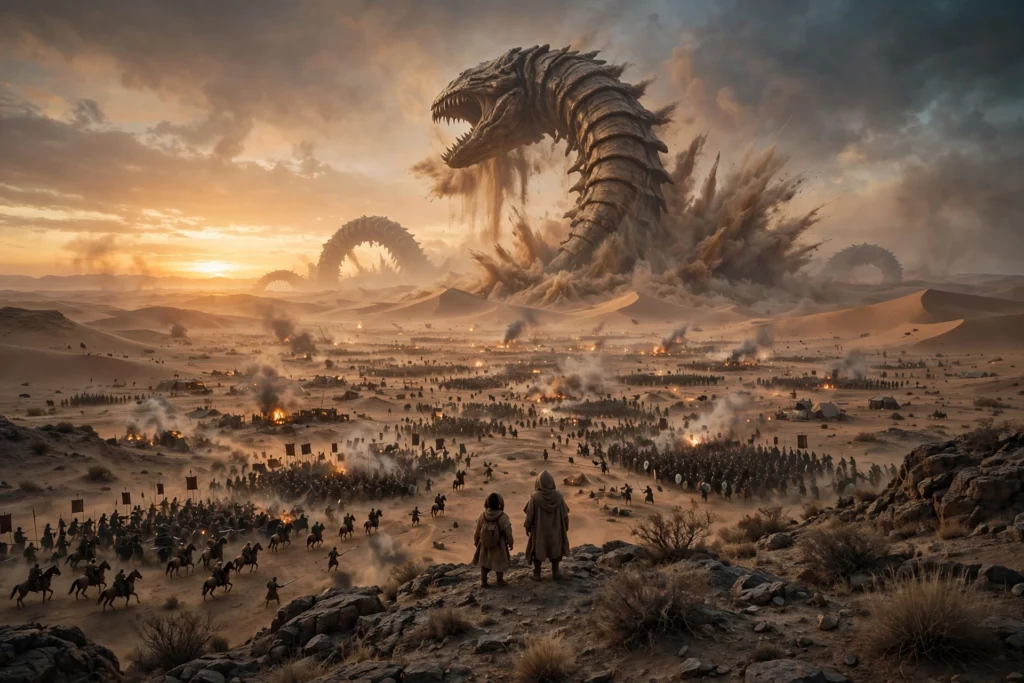
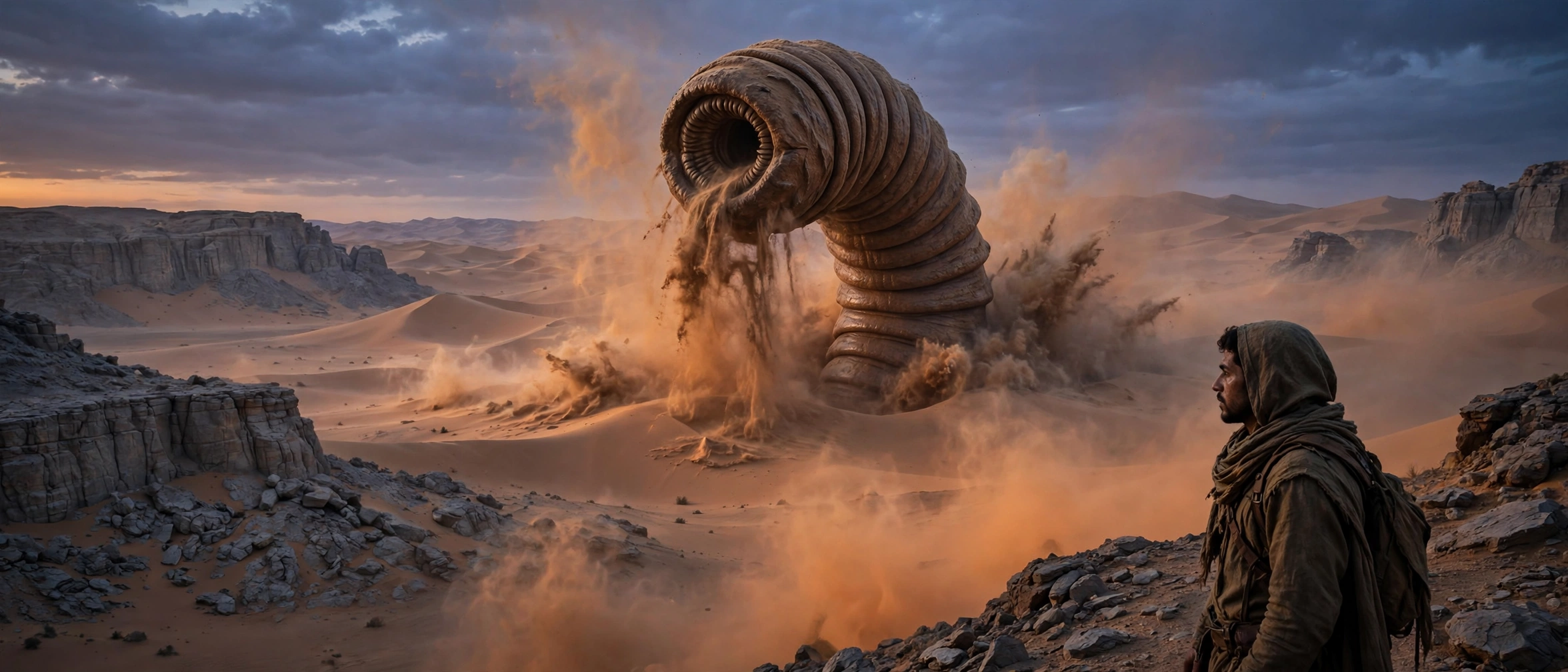
The shot: Silhouetted armies clash against a glowing horizon, sandworms rise through the dunes, and in the middle of the war the trailer gives its first glimpse of Paul and Chani’s twin children, Leto II and Ghanima — the next generation, watching the war their parents started.
Why it works: After six shots of rooms and faces, the trailer finally goes immense — and then shrinks the immense down to two small figures. The war is vast; what it costs is two children.
The AI prompt:
Photorealistic cinematic still, vast desert battlefield at dusk, a colossal sandworm rising through dunes behind clashing armies silhouetted against a glowing horizon, two small child figures seen from behind at a great distance on a ridge, tiny against the scale of the war, amber and ash grade, no text.
Tool tip: The children stay silhouettes at a distance — never generate a child’s face or a likeness of the young actors. Distance is what makes the shot work anyway: small figures, endless war.
Steal this style — copy-paste prompt pack
- “Dune Messiah look: cold imperial stone against spice-orange desert, bald scarred emperor, propaganda-scale armies, photorealistic cinematic still”
- “Palace intrigue in the desert: whispered conspiracies in shadowed chambers, a single candle or shaft of cold light, original fictional faces”
- “The oppressor’s palette: amber desert dusk cut by cold grey stone, bleached-white villain, blood as a single punctuation mark”
- “Villeneuve scale: vast IMAX-wide desert, tiny human figures against sandworms and armies, anamorphic widescreen, weighty stillness”
What AI still can’t nail
The honest part. The trailer’s biggest choices are story choices, not visual ones: Chani’s turn against Paul, the Face Dancer question of whether the Chani we see is really her, and Paul’s confession that he has become the oppressor. AI can render you a throne room and a sandworm all day, but it cannot stage a moral reversal, and it should not try to recreate Timothée Chalamet, Zendaya, or Robert Pattinson’s specific bleached Scytale look — use original faces and let the staging carry the scene. The Voice is a sound and a performance, not an image, so prompt the listener’s face, not the power. And the twins are child characters played by young actors: keep them as distant silhouettes, never as faces. Use AI for the look — the cold stone, the spice haze, the propaganda scale — and keep the betrayal, and the casting, human.
CTA banner: Want to direct your own version? Build the prompt shot by shot in the free AI Film Prompt Director (opens in new tab).