
Here’s the secret nobody tells you about making your first AI short film: the hard part isn’t the tool. It’s picking an idea small enough to finish.
I see it all the time — someone opens a video generator for the first time and types “an epic space battle with a thousand ships.” Twenty minutes later they’re frustrated and done. The tool didn’t fail. The idea was just too big.
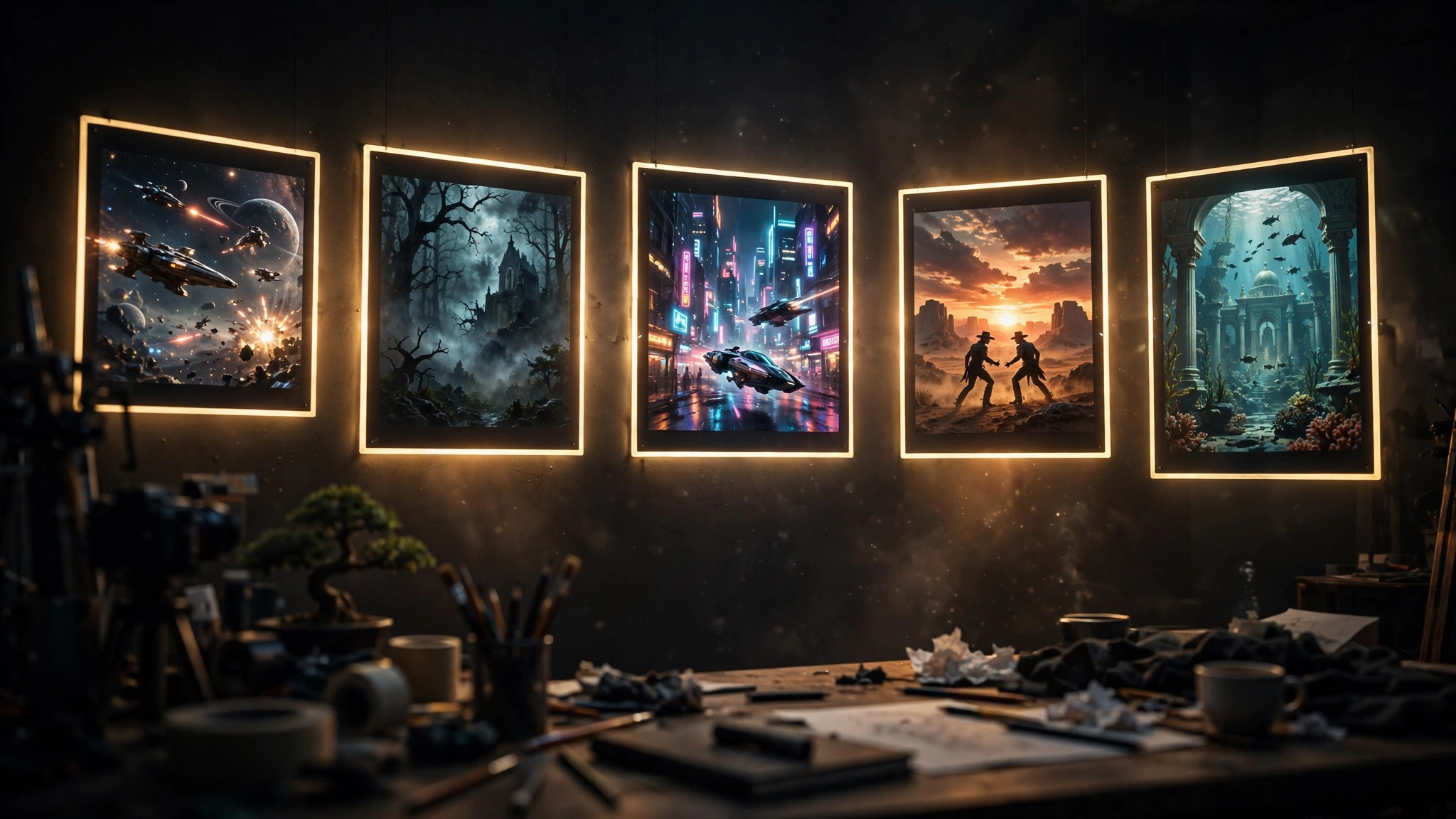
So here are five ideas built for beginners. Each one is small on purpose: few characters, almost no dialogue, strong visuals. Each comes with a logline and a six-scene shot list — roughly a minute of film. Pick one, follow the list, and you’ll have a finished short by Sunday night.
If you need a refresher on the workflow first, my beginner’s guide walks through it step by step: shot list, generate, keep the best, stitch, sound, titles.
1. The Lighthouse Keeper’s Last Night
Genre: quiet mystery. For thirty years, Elias has kept the lighthouse burning. Tonight the light goes out on its own — and something out in the fog is answering. A small mystery about the one night the keeper can’t explain.
Your 6-scene shot list:
- Wide shot: a lighthouse on black cliffs at dusk, waves crashing below
- Close-up: an old keeper’s hands lighting an oil lamp
- Wide shot: the lighthouse beam sweeping across dark water
- Close-up: the keeper’s face as the light flickers and dies
- Wide shot: a strange glow moving in the fog offshore
- Close-up: the keeper smiling, relighting the lamp as dawn breaks
Why it works for AI: one character, one location, and night lighting doing all the mood work. Fog and darkness hide every AI flaw.
2. A Robot’s Day Off
Genre: gentle sci-fi comedy. Unit-7 was built to sort packages. On its first day off in six years, it tries to understand what humans do for fun — and fails sweetly at all of it. A small, funny film about a machine learning to waste time.
Your 6-scene shot list:
- Wide shot: a small boxy robot standing alone in a warehouse at sunrise
- Close-up: the robot watching children play through a park fence
- Wide shot: the robot attempting to fly a kite, tangled in string
- Close-up: the robot holding an ice cream cone as it melts over its hand
- Wide shot: the robot sitting on a hill, watching the sunset
- Close-up: the robot’s screen-face showing a simple smile
Why it works for AI: a robot doesn’t need a consistent human face — the one thing AI struggles with most. And comedy covers every glitch.
3. The Storm
Genre: pure visual. No characters. No story. Just a storm rolling over a mountain valley, from the first dark clouds to the last ray of sun. Sometimes the bravest first film is the one with no people in it at all.
Your 6-scene shot list:
- Aerial view: a green valley under a clear morning sky
- Wide shot: dark clouds gathering over the peaks
- Close-up: the first raindrops hitting a lake surface
- Wide shot: lightning splitting the sky above the valley
- Close-up: wind bending tall grass sideways
- Aerial view: sun breaking through as the storm moves on
Why it works for AI: zero characters means zero consistency problems. AI video is genuinely great at weather and landscapes — this plays entirely to its strengths.
4. The Museum After Dark
Genre: creeping mystery. Mara, a night guard, has worked the museum for a year without incident. Tonight the statues are in different positions than she left them. She checks the cameras. The cameras show nothing — because the statues only move when she’s looking.
Your 6-scene shot list:
- Wide shot: a grand museum hall at night, moonlight through the skylights
- Close-up: the guard’s flashlight beam sweeping across the statues
- Wide shot: one statue’s head turned slightly toward the camera
- Close-up: Mara’s confused face as she checks her clipboard
- Wide shot: all the statues now facing her, flashlight flickering
- Close-up: Mara slowly smiling, switching off her flashlight
Why it works for AI: statues barely move — and that’s the point. Minimal motion means fewer weird AI artifacts, and the stillness is creepy all by itself.
5. Midnight Diner
Genre: quiet drama. It’s 2 a.m. at a roadside diner. A tired truck driver, a waitress on her last shift, and a stranger who pays for everyone’s coffee and leaves. Nothing explodes. It’s just the nicest ten minutes of their week.
Your 6-scene shot list:
- Wide shot: a neon-lit diner on an empty highway at night
- Close-up: coffee pouring into a chipped mug
- Medium shot: the waitress wiping the counter, exhausted
- Close-up: the stranger sliding a folded bill across the table
- Wide shot: the three of them laughing at something we don’t hear
- Close-up: the diner’s neon sign buzzing as dawn approaches
Why it works for AI: three characters, one room, no action scenes. Keep dialogue out and let faces, neon, and rain on the windows carry it — AI handles mood better than motion.
Need more ideas?
Five not enough? The free AI Film Idea Generator creates unlimited ones — title, logline, and full shot list with prompts, in four formats including narrated stories and ads.
Pick one and start
Don’t spend the weekend choosing. Point at one of the five, open your generator, and make your first clip tonight. Six scenes, about a minute, done by Sunday.
Your first film will be rough. Mine was. The second one will be twice as good — and you’ll only get there by finishing the first.
Want to see what a finished one looks like? Both episodes of THE LAST FLAME are up on my channel — and I wrote up exactly how I made them, mistakes included.